Well it’s been a while since I updated here and wow what a 6 months it’s been!
There have been plenty of awesome things for example my eldest married his beautiful fiancée
We have had days out a plenty. One of which was comic con
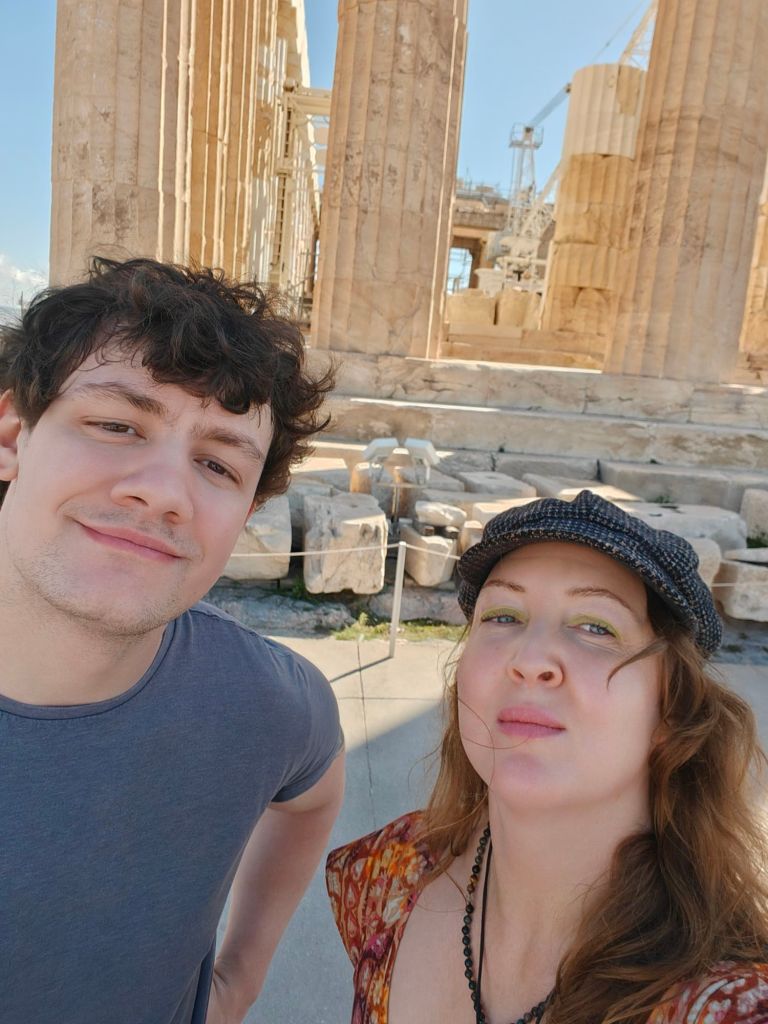
So much fun! A trip to Athens with my eldest which was lovely to spend some time with him before he officially became a married man!
There have also of course been downs. I had a pancreatic cancer scare. Thankfully all ok! My daughter had a precancerous breast tumor removed. Her tumours are always terrifying as she has PTEN harmatoma syndrome which means she grows tumours both benign and cancerous. She lost her thyroid to cancer at 10 years old. Thankfully after surgery she is ok although her chronic fatigue was quite bad afterwards.
All of the various ups and downs led me to overdo and after 6 months of 14 hour days I was exhausted, had a never ending sinus infection and then a chronic fatigue crash.
I am picking up now and later in the week will write about my experiences with having a crash after symptoms were under control for years and what it taught me.
That’s about all for now!
If you would like a female personal trainer, yoga teacher or Pilates instructor in Alnwick Northumberland who is well versed in different types of training including working with health issues please get in touch.
Yes I said revolution because resolutions always seem to be about giving up something. I revolt against that and am commenting to learning something.
In particular it’s olympic lifting. Which will be the main focus of my training for the next year. I will still use dumbbells for joint stability as I’m a bendy stretchy person but more as an accessory and a lil wod here and there to stop my heart exploding.
I have an amazing coach who I will see once a month and he can tell me where I’m going wrong and then I follow the program in between.
Today was day 3 of my year of olympic lifting, at this stage we are keeping it pretty light while I think about technique.
Today I particularly was aware in snatch balance of my tendency to land more on toes than heels which I’m working on. Snatch pull I find particularly useful as I really get the feeling of it being close to my belly.
I closed up the session with some split squats and heavy step ups then a short street parking work out. All in all body was thoroughly tickled
Interestingly my heart rate had a decent boomf from the olympic lifting
Well, I did it, or at least I hit 85% success. But by god by the end was it a pain in the arse. So here are my takeaways.
Photo by James Wheeler
If you commit to something like this keep in mind your life might change throughout the year. My training upped significantly and I went from teaching classes to becoming solely a personal trainer. Very quickly I was fully booked. This meant my activity level went up quite a good deal and keeping up with the steps some days was really tricky.
Build flexibility into any challenge. I really wish I had factored rest days in and had to add them in towards the end due to point 1.
Walking will improve your cardio fitness as long as you change speed, distance or add weight (back pack) my cardio has improved significantly and I can walk very steep hills with not much of a heart rate raise.
Walking is a great way to improve blood pressure. My BP had been a little erratic since I went into surgical menopause a few years ago and I was worried that it would start to become an issue. After the year of adding in extra steps it is now comfortably around 116/78.
I lost weight to begin with but added calories back in as I was getting super tired with all the extra training and teaching. I finished the year around the same weight although due to weight training with more muscle mass. In other words if you want to use walking as a weight loss method don’t eat anymore than you already are.
The dog will mostly love it if you have one, but even they some days will be like “for the love of god woman sit down”
Photo by Gabriela Palai
The next challenge I am starting is to see if there is any difference between walking a lot and more high intensity exercise. I will be using my Polar watch to do this. Currently it is set at the highest level of activity goal and my aim from Jan 24 to the end of Dec 24 is to hit an average of 100 percent 5 days a week. You will note the added flexibility here! Two days where I can be more restful, and the other days can be averaged which allows for a quieter day after a much busier day. I regret not allowing for averages during the walking challenge as some days I would hit 25000 steps but STILL have to do the 15000 the next day, Which beat me up a few times!
All in all though it was a reasonable challenge and if you are looking for a simple way to get fitter, reduce blood pressure and maybe lose some weight I would definitely recommend giving it a go for a year, but make it an average of 15000 steps a day over 5 or 6 days a week to allow a little wiggle room!
If you would like to have personal training in a private gym in Alnwick Northumberland please get in touch.
The past couple of months I’ve been working on setting boundaries. I am really not very good at doing this and basically want everyone I care about to be happy. I think it’s not uncommon for mums to find themselves in this situation, especially if they have children with additional needs. My 3 children all had significant challenges growing up ranging from depression, autism (and the unwillingness of the world to be a kind place to autistic people) to cancer and an especially nasty cancer causing genetic disorder.
I always saw it as my role to smooth things over, to make their life easier when at times it was far from it. Which of course is the right thing to do, but then I kept doing it not only for them but for well anyone I loved. I continually put myself last and well I found myself exhausted. Bone tired exhausted, regularly doing things for other people that actually they could do for themselves. I was the person who would say yes to everyone and bend over backwards to make everyone’s life easier.
You will think this is ridiculous, but it wasn’t till I started working with a counsellor dealing with some of the issues I have from childhood trauma and some of the awful years where my children were suffering that I realised this was a problem. Somewhere in my psyche I have a belief that in order to be loved I need to look after everyone. That unless I am making sure they are happy they won’t love me. Perhaps it stems from being years of being bullied, perhaps later years and bad relationships. I honestly don’t know. But it’s there as a belief and it’s one that I’m working with.
I started with family boundaries, allowing people to do things for themselves that they were more than capable of. There are people in my life who have significant struggles not all of which they can manage on their own I still help with areas they need. But I was taking on a lot that they are more than capable of and that was primarily my fault. I hadn’t set the boundaries for myself and felt my input was vital. The reasons of childhood cancer etc are more than understandable. But still that’s where I found myself, taking over when people didn’t actually need it.
But finding myself waking up at 5 am and not stopping till 8 pm was becoming unsustainable and I was just making myself miserable.
At 50 I am in a process of re-finding myself and allowing myself to come first sometimes. I was not just put on this earth to look after everyone else and nothing more than that. I deserve to explore my own joy and ambitions. I deserve to have time to read a book, relax in a bath or see friends. Other people deserve the chance to try and sometimes fail on their own and by doing so grow in the way we all have to.
That is a work in progress, saying no sometimes, and backing off when it’s not really my place to take responsibility.
The next set of boundaries I have started to set are with work. I am a self employed personal trainer which means everything is my responsibility from advertising to looking after equipment, keeping records on clients, planning and of course delivering the session. Not to mention the actual delivery of the session. For every hour taught there is another 20 to 30 minutes spent on setting the room up, then tidying it up, note making and planning.
After a month of a great deal of cancellations and numerous evenings on the phone re-arranging appointments I was talking to my counsellor who suggested that was another boundary I should set. He was of course right. I needed work boundaries. Just as I could not be there for family 24/7 I needed to have some stability in my working life. I previously had taught classes which is a very different way of working and not reliant on an individual in the same way. The transition into working out of a home gym means I am learning as I go along and I had not at the outset stated clear guidelines.
All of my clients are genuinely lovely people and likely hadn’t even thought about the issues it causes when there are a lot of cancellations especially last minute.
Before becoming self employed I did not realise the frustration of turning work away because I believed I was fully booked to have so many cancellations you lose a full day of work. I am a great deal more considerate now of my fellow self employed friends.
There’s the added complication that unlike a hairdresser or a beauty therapist for example I can’t fit in a new client ad hoc. To be able to see everyone in a given week I can only have a finite number of clients. Occasional clients isn’t really a thing in this line of work.
Any new client I take on is going to want regular sessions be it weekly or fortnightly.
I also want my little business to be as successful as possible and to be able to help as many people as possible in a given week.
My new rules then for work were
1. Not replying to messages after 6.30 pm
2. Instituting cancellation terms. Fairly standard ones nothing exciting.
3. If anyone really is unreliable let them go as a client.
I emailed everyone with my new terms and I immediately lost a couple of clients. Strangely they were clients who already did everything I had outlined in the cancellation terms, which really took me aback.
With both setting boundaries with family and with work there was a similar reaction, some people totally understood it. Others took it personally when it wasn’t.
As someone who struggles with setting boundaries any negative reaction is very tough, which is very much a me thing. It felt especially with loved ones like it reinforced my fear that to be loved I need to be forever available.
With family and friends I chose to focus on the people who loved me anyway, who offered to help me because they knew I was flat out busy. Who loved me regardless for who I am not what I do, even when I am too tired to have anything to give.
With clients it is a little more simple, they come and go it’s the nature of the business and I will always respect the choice of anyone who has decided it is no longer for them. Even if I will miss them.
When setting boundaries we do not control how the other person will react. That is an aspect of the process we need to accept.
Their reaction is their own and they absolutely have a right to it, that doesn’t mean it was wrong to set the boundary, although you may question yourself.
Each of us has a finite amount of energy and time to give to family, friends and work. Accepting that and working with it long term is to the benefit of everyone. None of us is a great deal of use if we are totally burned out and overwhelmed.
Now I have boundaries in place, as much in my mind as anywhere else I feel genuinely lighter and more optimistic for the future. I feel less like I am running to stand still and more like I can start to plan things to look forward to. It is never an easy thing to do, but if your lines are so blurred you don’t ever have time to yourself, time to relax or be open to plans and feel as though you exist for everyone else you may need to do the same.
Remember
You are entitled to boundaries both in your private and work life. You are not here to look after everyone else at the expense of your own health.
Not everyone will like it.
You don’t control how anyone else reacts or views your decision.
You may lose some people from your personal or professional life and not understand why.
It is still worth setting the boundaries, once through the process of doing so your life will improve as a result. Likely your relationships will benefit due to this.
If you would like a female personal trainer in Alnwick Northumberland who is well versed in different types of training including working with health issues please get in touch.
I am also a qualified yoga teacher and Pilates instructor.
In a previous post looking at the habits and lifestyle of people living in blue zones one of the aspects looked at was the importance of community, not only our own family but need for strong friendships. This isn’t a surprise, I think we all know the importance of having people in our lives who have our backs. It may however suprise you to learn that strong social networks appear to reduce our risk of heart disease, some cancers, make it more likely we will survive a health crisis and quite simply increase our chance of living a long healthy life.
But in the modern world it isn’t always that simple, working patterns, less interaction between neighbours, moving far from home all play into people becoming more isolated. Then throw in social anxiety, a divorce or caring responsibilities and it can seem impossible to expand our social circles never mind be part of a community.
This all makes the advise of having strong community links for the benefit of our health seem like empty words so what do we do?
Honestly it’s not an easy situation but I have had to rebuild my circle from scratch more than once, in my early 20s after a big relationship break up, in my 30s when I moved to a different town and then in recent years when after a long period of caring for my daughter I found I had lost many friends during her illness. Here’s a list of ideas based on what I found worked for me:-
Photo by Alena Darmel
Be open to opportunities for new friendships, if you really hit it off with someone ask them out to coffee, the worst that will happen is they politely say no.
Join stuff, all the stuff! Anything that takes your interest, book clubs, Spanish classes, true crime groups, gyms. Really anything that you will enjoy that also gives you a chance to meet people. The enjoying the actual activity is an important aspect as it might be that there is no one there that you gel with but it gives you an activity to look forward during the week regardless. That in itself is confidence building
Be open to trying entirely new experiences, maybe you actually are a budding surfer or ariel yogi.
Apps these days are amazing, there are meet new friends apps such as peanut and one of my favourites MeetUp which has events and get togethers close by listed. Although I have yet to find something in my town via MeetUp I have joined a couple of really fun groups in the nearest city.
Realise that you are not going to be everyone’s cup of tea and that is actually ok, there may be places where you just don’t fit. If that is the case just move on, it’s impossible to make yourself fit somewhere you don’t and wastes time you could be spending on other more fruitful situations. A rule of thumb as to whether you don’t fit somewhere is if you stop going does anyone from that social situation or group stay in touch or reach out? If the answer is no, especially if you’ve been part of that group for sometime chances are they aren’t your people or your friends. If people from that group actively shun you once you are no longer part of their network they absolutely were never friends in the first place. Harsh, but better to figure it out sooner rather than later.
To a lesser degree the same applies to individuals, if you only ever reach out and it is never reciprocated as far as suggesting plans etc question if that person is actually there for you. There are times when people are just overwhelmed with work or family responsibilities which is understandable but there are also people who will just take advantage. Before my daughter developed cancer I had some what I thought were really close friends, I was always in the supportive role of their lives and dramas. The second my daughter became ill and I was the one needing support two of my oldest friends vanished and I didn’t hear from them again. I am now much more aware of the signs of people who will use me to their benefit. Building your community means finding people who will support you, not just people who want your support.
It is even more likely there will be places you don’t fit if like me you are neurodiverse. Don’t worry though your weird soul friends are out there and you will thrive all the more when you find them!
Re-connect with old friends, if you stopped seeing each other due to circumstance rather than a break in the friendship there is a good chance that whatever was there before still is. It can be tricky to reach out out of the blue but most of the time we are actually thrilled to hear from someone we share history with.
Once you start to build your little community of friends be patient, each new friendship is like a seedling. Some will grow others may not. Focus on the friendships that are growing and nurture them with your time.
Make plans. This is an obvious one, but it can be very easy to put off seeing people over and over again. Especially if busy with work and family. I don’t think I’ve ever made time for a friend and regretted it, even when I’m exhausted.
Most of all enjoy the process, it can be daunting as an adult to make new friends, but it can also be a huge amount of fun if you let it!
Photo by Polina Tankilevitch
Good luck and here’s to all the beautiful people in our lives who bring joy to our days, wine to our glasses and laughter to our bellies and nourishment to our souls! I am very lucky to have a batch of people in my corner now who I know have my back and who I hope realise I have theirs.
If you would like to work with a personal trainer in a quiet setting in Alnwick Northumberland get in touch!
What are the benefits and risks associated with fasting? Fasting over the past few years has become pretty mainstream with various iterations featured in books that grace the shelves of high street shops. Popular versions include 16/8 where you don’t eat for 16 hours and limit your intake to an 8 hour window, 18/6 same but longer restriction period, 5/2 this is 5 days of normal eating and 2 days of 5 to 800 calories. The eat fast eat methods all come under the umbrella of intermittent fasting. Then there are the longer or prolonged fasts and fasting mimicking plans such as Prolon which is a scientifically designed very low calorie plan.
All sounds pretty amazing doesn’t it? Especially if it’s just a case of skipping breakfast! Except the science is not yet behind the idea of intermittent fasting, in fact a year long study disputes the majority of the claimed metabolic benefits[2][3]
Photo by Elle Hughes from Pexels
That is not to say there are no benefits and that if you personally find it helps with weight loss, calorie maintenance or feel it suits your lifestyle that you should give it up. The science is also not entirely conclusively against intermittent fasting, for example a study of breast cancer survivors found that those who had more than 13 hours between the last time they ate in the evening and the first time they ate in the morning was associated with a 36% reduction in the recurrence of breast cancer.[4] It would seem that our bodies being constantly bathed in calories is not long term good for us. It needs periods of rest and recovery.
However, it looks unlikely that some of the really interesting aspects such as autophagy take place over such short periods of restriction. Autophagy translates as self eating, in this process when the body is not taking in enough calories in particular it seems proteins it will scavenge it’s own system in order to find the necessary proteins. In particular damaged cellular matter is broken down first, this makes sense, if we face financial hardship we will mend or repurpose damaged items while leaving new perfect goods alone.
It is the process of autophagy where the real magic of fasting lies, through this process we can reduce inflammation, reduce our risk of tumors, delay the aging process and increase the production of tumor killing cells.[5]
When fasting is combined with chemotherapy it seems according to some studies reduce the risk of side effects by sending the healthy cells into a protective state while leaving the fast growing mutation cells open to attack.[6]
Photo by Engin Akyurt from Pexels
It’s all pretty exciting stuff really and a great deal of research is currently going on looking at various medical applications of both fasting and fasting mimicking diet. The fasting mimicking diet is the brain child of Professor Valter Longo and allows for a small almost protein free intake of calories over the fasting period.[7]
The caveat in all this is that it takes at least 2 to 4 days for this to take place and not the few hours of restriction we were all hoping for.[8] The ideal period of fasting is around 5 days.
It should be noted that autophagy can also be triggered by long periods of calorie restriction which may be a more suitable path for many, in order to trigger autophagy a restriction of 40% of normal intake is necessary, so for example if your intake is 2000 a day reducing it to 1600 for a few weeks will result in a degree of autophagy[9]. I will likely write a separate post on this another day.
Such longer term periods appeal to me less purely because at the moment training is very important to me which means I eat at or slightly above maintenance calories which supports my energy and post training recovery. Fast and hard is my preferred method (pun intended) to this and many aspects of life.
I have used Longo’s fasting mimicking plan a few times now, 4 maybe 5 times I can’t quite remember. The last time was nearly 9 months ago! I had planned on before Christmas but family responsibilities, social engagements etc meant I kept having to bump it forward. I set a specific date for Feb, which is next week, put it in the calendar and turned everything that tried to crop up down other than a couple of non-negotiable appointments for my daughter!
I prefer during fasting weeks to turn life down, I did during my first one attempt to train and live as normal and by day 4 I felt awful. I mean really really awful. After that experience the next attempts were undertaken a little more sensibly. I take the week off work and focus on nurturing myself and allowing for rest while I push my cells into a repair cycle. I think it’s reasonable to allow myself time to do this and as it’s 2 to 3 weeks in a year maximum stepping back a little is no bad thing. It’s also one of the many benefits of being self employed! Plus if it gives me chance of
Of course it is necessary to mention that fasting and fasting mimicking plans are not without risk, during the 5 days it is possible to experience fatigue, dizziness, feeling cold and of course hunger. As I mentioned earlier when I pushed too hard I did feel genuinely dreadful and learned my lesson. The biggest risk however is something called re-feeding syndrome which can be deadly
“Refeeding syndrome can be defined as the potentially fatal shifts in fluids and electrolytes that may occur in malnourished patients receiving artificial refeeding (whether enterally or parenterally). These shifts result from hormonal and metabolic changes and may cause serious clinical complications.”[10] It is rare but necessitates that the two days after fasting involve a gentle re-introduction of food rather than rushing to McDonalds for a big mac. It is less likely with the fasting mimicking plan due to the very small caloric intake keeping the digestive mechanisms running. However they still recommend a slow return to nutrition.
Photo by Krishnajith from Pexels
There are a number of scientists working in the realm of aging and longevity all with different ideas and methods, however one area in which they all seem to agree is that short periods of fasting (5 days for full benefits) are one of the most reliable methods of reducing disease risk and promoting a longer healthy life. Nothing in life is guaranteed, but if a short period of discomfort can shift the odds in my favour I’m all for it! See you on the other side!
If you would like to work with a personal trainer in a quiet setting in Alnwick Northumberland get in touch!
Some people excel at sport and athleticism from an early age, it is woven into their DNA. They take to any physical activity they try with ease and grace. The kind of people who won every race at sports day and captained every team. Then there’s those like me who were quite literally picked last for every team in PE, I swear to god if my classmates could have chosen the school bench over me they would. To be fair it would have probably done a better job at the time.
I was skinny, knock kneed, had an undiagnosed hypermobility spectrum disorder and the serious lack of muscle tone that goes with it. As is often the case when we are awful at something I avoided it like the plague, I don’t know if things have changed but in my day PE teachers had no interest in those without natural athleticism never mind the reasons why.
To be entirely honest my experiences at school with regard to fitness were not just negative they were actually traumatic. I was openly bullied for my lack of physicality and knock knees and viciously name called. I’m not sure though out of the laughter or the pity clap I would sometimes get coming in dead last for something…again which one was worse. I still won’t even so much as take part in a 5k race in public as a result, the idea of any type of competition fills me with horror to the point where I actually feel physically sick.
Why am I telling you this? It’s not for pity or sympathy, I am honestly quite fine. The past is the past. I want you to read this if you like me had no natural ability and let you know that it does not and never did exclude you from looking after yourself physically. No matter how rubbish you were at PE you can still benefit from various forms of movement. Heck you might even enjoy it. I certainly do, in fact I can’t imagine a life where I don’t get up and exercise pretty much every day. I am so grateful that I discovered first yoga and Pilates in my 20s which I found I actually quite naturally built for and being the antithesis of competitive sports allowed me to tune in with my body and learn to love moving it. It was this love of movement I took into CrossFit and strength training, the difference being in that situation I was pretty rubbish to begin with. However many years later of keeping at it I am actually
pretty strong and certainly fit.
That for me is the important aspect, being fit and healthy, being strong enough to squat down to the ground with a heavy back pack and stand back up, being able to walk briskly up hills without losing my breath, being limber enough to fold into my legs with no discomfort, being able to lift heavy suitcases over head for other passengers on trains. These are the things that matter to me. That and the sheer love of movement, oh heavens it is simply glorious to just move, there is a delight in using your body that is with language almost inexpressible. As though different movements all have their own flavor and to engage in more than one is like a banquet for the body. Plus as a result I honestly feel better at nearly 50 than I did my entire adult life.
Don’t let a perceived idea of not being athletic dictate to you that exercise isn’t for you, it is for everyone from those like my husband who are naturally talented in a particular field (running) and thrive in competition to those like myself who myself who had to work at it. In fact I think those of us who are not naturals potentially benefit even more as there are often underlying conditions that make us that way which are improved by movement.
Exercise is for all of us and is certainly one of the keys to health and longevity.
If you would like to work with a personal trainer in a quiet setting in Alnwick Northumberland get in touch!
And I would walk 15000 steps, and I would walk 15000 more…Just to be the one who walked 15000 steps a day or more. You are very welcome for the brain worm I’ve implanted, now lets get on.
Photo by Tatiana Syrikova
As I mentioned in my post on Blue Zones aside from eating a diet devoid of processed food and high in vegetables plus fruit the centenarians moved a huge amount throughout their entire lives. In fact they on average only rest for 8 to 9 hours a day and that includes sleep, most of it is low intensity gardening, walking place to place with distances of 7 to 9 miles not being uncommon. Compare that to the UK where the average step count is a paltry 3000 to 4000 a day[1]
Photo by Alex Azabache
Movement throughout the day or Non-Exercise Activity Thermogenesis (NEAT) has a huge impact on weight, insulin sensitivity and metabolic health.[2] But I exercise I hear you cry, the question then is if we go to the gym a few times a week does that actually make up for spending the rest of the time sitting? Apparently not, if after a bout of exercise, the rest of the day is spent sitting or driving you are still losing out on your primary method of thermogenesis (calorie burning) and as a result are still at risk of a number of metabolic diseases[3]. In fact even in elite athletes sedeantary time outside of training leads to increased abdominal adiposity[4] leading the researchers to conclude
“These findings indicate that athletes with higher amounts of sedentary behaviour presented higher levels of total and trunk fatness, regardless of age, weekly training time, and residual mass. Therefore, even high moderate-to-vigorous physical activity levels do not mitigate the associations between sedentary behaviour and body fatness in highly trained athletes.”[5]
As the average age of the cohort researched was 22 this is a little concerning!
It’s not a huge surprise, then that as a nation we are getting bigger, and we are also in general getting sicker.
As hunter gatherers we would have averaged around 16 to 17000 steps a day, we would also have carried chopped and engaged in other physical activities, there are tribes who still live like this although they are becoming a rarity, when moving this much and this often-cardiovascular disease is rare[6] Perhaps it is not the type of exercise or movement we engage in that matters but how often we move, it will come as good news to those who don’t enjoy exercise that you don’t need to engage in vigorous activity either to benefit, you just need to move often. Although I would always recommend both strength training and mobility training for optimal aging.
Photo by SHVETS production
In more recent times such as the 1950s women were estimated to burn around 1000 calories on top of their basal metabolic rate (the calories needed just to exist) through walking, cleaning, cycling and other activities.[7] While men depending upon their profession could burn more through their work and commute to and from work. Few people had cars, most lived close enough to their place of occupation to walk to and from work and children would be unlikely to get to school any other way than by foot.
Now I am not suggesting we relinquish cars, washing machines and all return to working as Shepherds (though it does sound pretty idyllic) but it is clear we move less than we ever have and the truth is it is not doing anyone any good.
Photo by Rachel Claire
I came to the realisation that I was not immune from this sedentary behaviour, I like to think I am relatively fit for my age, I strength train, use a stationary bike 4 or 5 times a week, CrossFit regularly, practice yoga and walk the dog. But the truth is that although I exercise daily and walk the dog on top the rest of the day I am sat down, I am working towards my PhD which is of course desk work and I now teach and train people primarily from home.
Like a lot of people then my movement has dropped. I want to stay as healthy as I can for as long as I can and do what I can to promote a long healthy life. I decided then mid October to walk a minimum of 15000 steps a day. This is based on research on postal workers that found 15000 steps was optimal for blood pressure reduction, cholesterol reduction and many other health benefits[8] I decided initially on a period of 9 months which would take me to my 50th birthday. I then changed that to a year. I believe that to fully appreciate the benefits of any change we have to commit to a reasonable period of time as these types of changes don’t happen quickly. I am particularly interested in changes to my blood pressure, since surgical menopause it sometimes creeps higher than I would like. Not high enough for a doctor to be concerned they reassure me, but outside of the bounds I would be comfortable with. According to the American College of Cardiology a higher step count is linked to lower blood pressure.[9] I would also like to see a reduction in cholesterol, on my last check my levels were at the upper end of ok.
The rules I set myself were as follows:-
Any “steps” count for example if I cycle 15k on my bike erg my watch will register around 5 to 6000 steps. This is helpful as due to caring responsibilities I cannot always leave the house. It is important that any goal we set is achievable and fits into the life the live not the life we would like to live. Equally all steps around the house, shopping etc count. It is simply the total step count at the end of a day.
I am aiming for 90% compliance across the year, as with everything consistency is more important than perfection. There will be times I have responsibilities to others or it might be inappropriate to go for a walk, or when I am too unwell.
I will continue to exercise and eat pretty much as I was, this for the year is the adjustment I am making.
Each day has a target of over 15000 regardless of the previous day, I am not averaging across the week. So, for example if one day is 22000 steps it is irrelevant to the following days activity, I still aim for the 15000 steps. My logic on this is that if I lived in pre-industrial environment I would still need to fetch water and food that day regardless of what I had done the previous day.
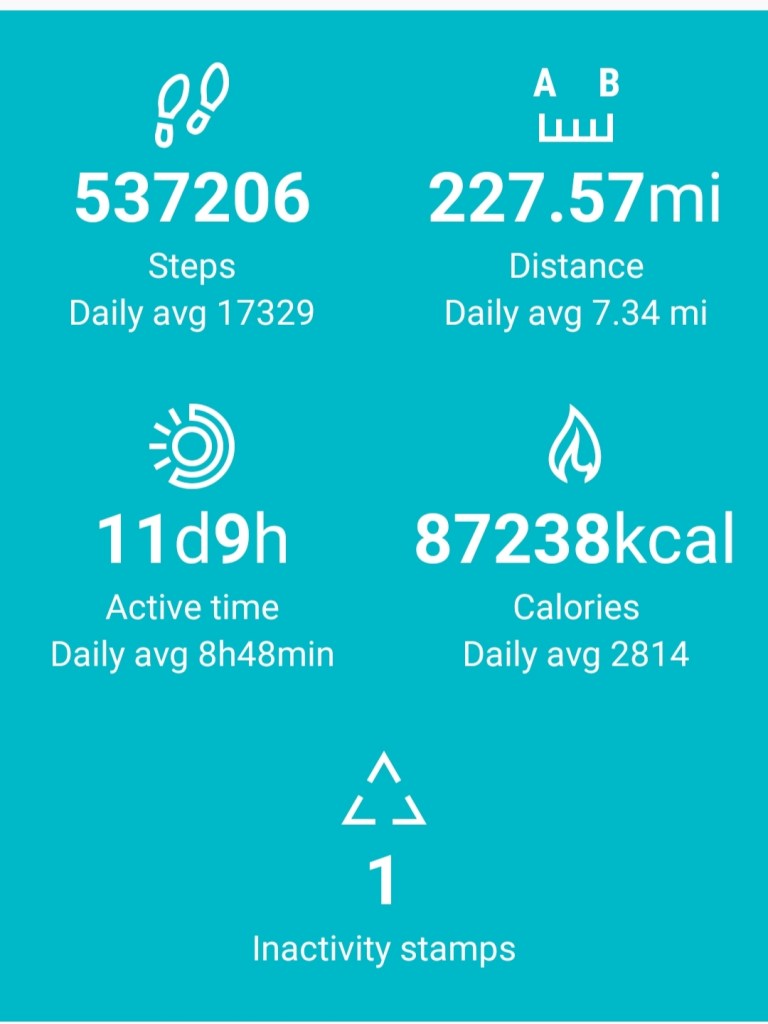
I am currently at the end of 4 months and on average have exceeded my target with an average of 17000 to 18000 steps a day and within the 14 weeks have missed only one day.
That day was the day we were traveling on holiday and although I was at 11000 steps it was way too late when we arrived at our accommodation to try explore a new place. Still 1 day missed in 14 weeks is pretty good if you ask me. Things I have learned during this time trying to get over 15000 steps:-
November, December and January
Some days it’s really easy, I will be on the bike in the morning, walk the dog, train a couple of clients, run some errands and before I’m at 1 pm I have already hit the target.
Other days it’s really hard, as in oh my word how many more do I have to do today, how am I not there already and do I really need to go back outside? Really?
For me it is important to be entertained, to fit in the bike and/or walking it is part of my relaxing time, what this means is when I am on the bike I watch tv. I particularly enjoy shows with subtitles as being on the bike means I am captive in my focus, currently I’m working through a selection of Korean sci fi/supernatural dramas. Walking it’s podcasts or books, I will only listen to those books or watch those shows when I’m biking or walking. That way I actively look forward to getting back into my book and the walking is almost subsidiary. If you walk occasionally in the countryside on a beautiful day it may well be enough to just listen to the sounds of nature, if you are planning on walking every single day, in the rain, in the dark, in the snow often next to noisy dirty roads in order to fit it in the sounds around you may seem less attractive. Find something to entertain you!
Having this challenge has meant I have walked on days I would not have otherwise, when I am tired or under the weather. In the past I would have asked someone else to walk the dog, but I remind myself that if I lived in a hunter gatherer community or was a shepherdess I would only take days off if I literally could not move. You would not just stop for feeling a little under the weather. Granted those days are not dynamic walking but I am up and moving. This week for example I have a nasty sinus thing going on, I am not well enough to train or do much really but walking is so much of a neutral activity now I have been able to slowly shuffle around and get my steps in.
I don’t actually weigh myself as it’s not a metric I am particularly interested in but I have lost weight, some clothes have become looser and snug waist bands now are somewhat baggy.
My cardio has improved significantly, I walk brisker than ever with little effort and don’t feel at all breathless up hills
I am leaving measuring blood pressure etc till much later in the experiment, I will be getting I believe a full MOT at 50 which will be a good time to check over all my health stats and as it will be 9 months since I started this experiment will be a good time to assess how I am doing!
If you are reading this, start tracking your day to day movement with phone, watch or pedometer and find out how active you are outside of formal exercise.
If you would like to work with a personal trainer in a quiet setting in Alnwick Northumberland get in touch!
What are blue zones and why do they matter for healthy aging?
What better way to know what works in sustaining a long healthy life than learning from those who have already reached over 100? Rather than having a hypothesis and testing it with regard to longevity these are people who have already successfully achieved the result we all want, a long healthy disease free old age. It seems that we have a good chance of doing so too should we wish, a Danish twin study established that only 20% of aging is genetic the other 80 in how we live[1]
But how should we live? That brings us to what are now known as The Blue Zones, in the early 2000s journalist Dan Buetter[2] set out with the help of the National Geographic to discover the areas of the world where people lived the longest and what secrets their lifestyle would reveal. He planned to find not only areas where there was a large number of centenarians, but the population had less of the diseases that have become common in the Western world; diabetes, heart disease, obesity etc.
In his research he identified the following 5 areas-
Ikaria, Greece
On this Mediterranean Island they boast some of the lowest global rates of middle age death and dementia believed in large to be due their traditional Mediterranean diet free from processed foods and rich in vegetables, fats with some meat and dairy.
Okinawa, Japan
Here some of the world’s most long-lived women enjoy an excellent later life, they have a natural diet containing plenty of Okinawan sweet potatoes, soya beans, mugwort and turmeric.
Ogliastra region, Sardinia
A mountainous Italian region where the highest proportion of oldest men in the world live, they eat a predominantly plant based diet that is low in protein and is according to some research linked to lower levels of mortality in under 65s along with lower rates of cancer and diabetes. Professor Valter Longo[3] an eminent researcher in the field of longevity recommends a low protein diet as a result. He is involved in a number of research projects examining the benefits of a low protein diet and fasting.
Loma Linda, California
The largest number of Seventh-day Adventists can be found here, they live around 10 years longer than the average American. Their vegetarian diet consists of grains, fruits, nuts and vegetables. They also eschew spices, alcohol, and caffeine.
Nicoya Peninsula, Costa Rica
The second largest number of centenarian men can be found with the locals subsisting on a diet of vegetables, beans, rice, some meats and coffee[4].
It is easy to spot the commonalities with regard to diet, the diet in each area is unprocessed and based around whole foods. The foods themselves vary from vegetarian to meat eating some with dairy some without, the Seventh-day Adventists are teetotal, the Mediterranean areas enjoy a little wine. However, they all have a focus on home cooking, quality ingredients with high levels of vegetables and fruits.
Perhaps then it does not matter what our dietary preference is be it Vegetarian, Vegan, Paleo or Omnivore. The key may be as simple and common sense as eating a largely unprocessed diet of whole foods and ensuring plentiful vegetables and fruit throughout the day. The finer points being up to each of us to decide.
A great deal of this may not be news to you, I think we are all aware of the need to eat a whole food unprocessed diet and particularly of the benefits of fruit and veg. In fact I would say the dietary aspect of the blue zones has been the most highlighted in the media and has been the subject of the greatest wealth of further research. In particular the Mediterranean diet.
However we can’t simply pick one aspect of these areas in isolation from the rest of the life style, what about the rest of the day to day life of those who enjoy health and extreme longevity.
All of the blue zones had other characteristics that are of equal important to dietary habits.[5]
1. Movement, in each area people are active right the way through their lives, in the mountainous areas of Sardinia walking miles in hilly terrain is normal, the Seventh-day Adventists engage in deliberate daily activity. Compared to the Western world’s standards very high levels of activity are normal. Walking to commute for example remains part of life into peoples 90s as does engaging in physical jobs and hobbies[6]
“the average time spent sitting per day for Ikarian residents≥90 years of age is 90 min per day. Similar results with a different form of measurement were reported for the Sardinian participants≥90 years of age regarding productive rest. The total daily resting time was measured by the participant’s duration of night’s sleep and time spent in supine in the waking day, which resulted in only 8.5 hours for men and 7.4 hours of total daily rest on average out of a 24-hour period”[7]
This is a stark contrast to how aging is both seen and treated in the UK and America, activities tend to be wound down with age and older people are often encouraged to take it easy rather than get out and about.
2. A sense of purpose, having a reason to get up in the morning, a why is linked to longevity and common within these communities.
3. A sense of belonging and community, again all of these regions have strong senses of community and involve elders actively within the community. Social connections are connected to not only greater quality of life but longevity.
“by the time half of a hypothetical sample of 100 people has died, there will be five more people alive with stronger social relationships than people with weaker social relationships.”[8]
Friendships and being included within daily life quite literally can save your life. Again contrast this with the way elders are treated within the UK and the US, often isolated, lonely and far away from family members. Loneliness and isolation are associated with heart disease, stroke, Alzheimer’s and other serious health issues. In fact, the risk may rival smoking.[9]
It is also worth being aware that intergenerational friendships (a part of life in blue zones) benefit not only the older individual but also the younger person. Both gain different perspectives and are able to share valuable insights, in cases where older individuals mentor young adults it was found
“55% less likely than their peers to skip a day of school
78% more likely to volunteer regularly
130% more likely to hold leadership positions”[10]
Community is good for all of us it seems.
4. Healthy friends, it doesn’t come as a big surprise that the people we spend time with influence our behaviours, in other words if you want to live a long healthy life spend time with people who encourage healthy behaviours.
In short, eat well, eat plenty of plants, move a heck of a lot more than you probably do and spend quality time with good people of all ages who encourage you to do all of the above! I realised a few months ago that although I exercised regualrly I also sat a lot during the rest of the day, due to this I set myself a 15,000 steps a day challenge which I will post about later. I have also joined a few new social networks as my social circle shrank dramatically when my daughter was unwell for a few years. We maybe can’t follow all of the recommendations but perhaps by getting as close as we can to the lifesyle ot the blue zones we will live just that little bit longer and perhaps more importantly those years will be in good health. Let me know what you plan to do help add a few years to your life and life to your year!
If you would like to work with a personal trainer in a quiet setting in Alnwick Northumberland get in touch!






















 Sam Kelly Fitness