Perhaps like a lot of people in the new year you are thinking about dusting off your trainers and getting back into exercise? The question is how do you set yourself up for success? Whether you’re returning after a long break or just revamping your routine, it’s crucial to approach it thoughtfully and safely.
First things first—be gentle with yourself as you restart your fitness journey. Begin with light workouts or physical activities that you genuinely enjoy, like cycling, dancing in the kitchen swimming, or even brisk walks. The key is to ease your body back into the rhythm of regular exercise without overwhelming it. If you are wanting to learn a new skill such as yoga, Pilates or start resistance training with free weights I would strongly recommend classes or a trainer. That way you learn the correct form and exercises can be adapted to your needs. This is especially important if you have old or existing injuries or underlying health conditions. Nothing ruins a good intention like an injury.
Photo by Kampus Production: Pexels
As you get comfortable, you’ll want to introduce a concept known as progressive overload. This means gradually increasing the weight, intensity, or duration of your workouts to continue challenging your muscles and seeing improvements. It’s a crucial strategy to keep progressing, but always listen to your body and adjust accordingly. If you don’t incorporate progressive overload at best you stop progressing but at worst you can even regress. The body is incredibly good at adapting which means if you don’t continue to challenge it, your body will adapt to the stimulation so we’ll the starting program will no longer do much. If you are working with a trainer or coach they will handle this aspect for you.
Photo by Marcus Chan: Pexels
After a while you might lose the motivation to continue, you will I’m sure have very personal reasons as to why you started it’s worth remembering this initial motivation. Here are a few potential reasons to move that hopefully will keep you motivated.
1. **Bone Health**: Regular exercise, particularly weight-bearing activities like walking and weightlifting, is essential for maintaining bone density. This helps prevent conditions like osteoporosis, keeping your bones strong as you age (Hamdy, 2021).
2. **Preventing Sarcopenia**: As we age, muscle mass naturally declines, a process known as sarcopenia. Staying active and engaging in resistance training can slow down this process, helping maintain muscle strength and size (Janssen, 2018).
3. **Independence and Enjoyment**: Fitness isn’t just about looking good—it’s about feeling good and being able to live life on your terms. Regular movement helps maintain independence, making daily tasks easier and more enjoyable. Whether it’s playing with your kids, gardening, or dancing, staying active enhances your quality of life.
Finally how do you set yourself up for the best chance of success?
– **Set Realistic Goals**: Start with achievable targets and slowly increase them as you build strength and endurance.
– **Find a Buddy**: Sometimes, having a workout partner can provide extra motivation and make activities more enjoyable.
Photo by Elina Fairytale: Pexels
– **Hire a Trainer**: Perhaps you already know you struggle with what to do and when or sticking to a program. Having an appointment keeps you accountable and takes care of “where do I start and what do I do”. It is also really important to seek the advise of someone who knows what they are doing if you are recovering from illness or injury. Part of which might be getting clearance from your doctor then seeking a trainer who can work with/around that condition.
– **Celebrate Small Wins**: Every step forward is progress. Celebrate milestones, no matter how small.
– **Remember why you started**: Keep in mind your personal reasons for starting as well as those listed above. Exercise is a lot like brushing our teeth, we don’t always want to do it, but we know it’s critical to good health.
Remember, the goal is to enjoy the journey as much as the results. Stay patient, be consistent, and your efforts will surely pay off.
If you would like to have personal training, yoga or Pilates in a private gym in Alnwick please get in touch.
– Janssen, I. (2018). The Challenge of Sarcopenia: Musculoskeletal Declines with Aging. *Public Health Reviews*, [online] Available at: <https://www.publichealthreviews.com>
If you would like to work with a personal trainer also qualified in yoga and Pilates in a private home gym in Alnwick please get in touch.
When someone is feeling less than wonderful it’s common to try something and after a while it’s amazing. They start to feel better. Feel better to the point where yoga, Pilates, weight training whatever it happens to be becomes a passion. They want to tell everyone how fricking amazing Pilates is, how they felt awful beforehand, but now they feel pretty good.
Photo by Prasanth Inturi
But then it stops working, but that’s ok they try something new. Maybe going plant based or paleo and that becomes the new magic pathway. Then that stops working and so on.
So what gives? Possibly a few things. Firstly there is a very reductionist and polarising attitude towards life at the moment and it’s prevalent in the health and fitness space particularly. People are in particular camps, they are yogis, or weight lifters or runners. You can see fitness folk arguing in the comment sections of social media about which is better and why. Each of the adherents arguing their case as to why they are right, why weight lifting is better for far loss, or runners have the best VO2 max and that’s more important. How yoga reduces cortisol which does xyz.
Photo by Anna Shvets
Reality is we need a bit of all of them. We need some cardio for heart and lungs, strength training to prevent sarcopenia and frailty in later years and yes mobility too. Because what’s the point of the first two if you can’t get off the floor due to zero mobility?
So that’s a possibility, you had a piece of the movement puzzle but not the whole thing which meant that for example if someone was dealing with POTs they made progress through running but needed strength work also to improve blood flow.
Perhaps someone started a program but haven’t progressed. In other words still doing the same exercises again and again without any progressive overload. Without making them harder. When that happens the body responds to the stimulus but then gets to that stimulus, unless it’s made more challenging in order to again introduce stimulus detraining can even occur.
Or maybe once someone has an exercise routine sorted their body starts to change and needs better nutrition, more sleep. Other pieces of the puzzle.
Photo by Monica Silvestre
If this has happened to you think of the following
What is the quality of your sleep like?
How much daylight do you get each day?
How many steps do you take a day?
How much blue light are you exposed to?
Do you have time away from blue light before sleep?
How much of your diet is real food? Doesn’t matter what your preference is but looks at how much is something that would have existed before processed food.
Do you have time to relax? Are you genuinely de-stressing?
Are you too comfortable all the time? Do you ever deliberately get out of breath, too hot, too cold or hungry?
Weirdly the body responds to adversity the rule of hormesis. In other words the biological phenomenon where a low exposure to a potentially harmful agent, like a toxin or stressor, can have beneficial effects on an organism. At a low dose of course.
Photo by Pao Dayag
Obviously I’m not saying try and do all these things at once, a total life overhaul is unsustainable BUT if you found an exercise routine that is working or a dietary pattern that helps you but you feel you are no longer getting results. Don’t stop what was working and do something entirely different, maybe tweak it. Make the exercise tougher or add in cardio/strength and then look at sleep or steps. Then after a few months add something else.
The reality is for optimal health we eventually need to look at all of it. Rather than expecting a magic bullet we need to accept that the human animal needs to eat well, move regularly, get daylight and sleep effectively. Any single piece of the puzzle missing can leave you feeling less than awesome.
If you would like to have a personal trainer with a holistic approach working out of a private home gym in Alnwick Northumberland get in touch!
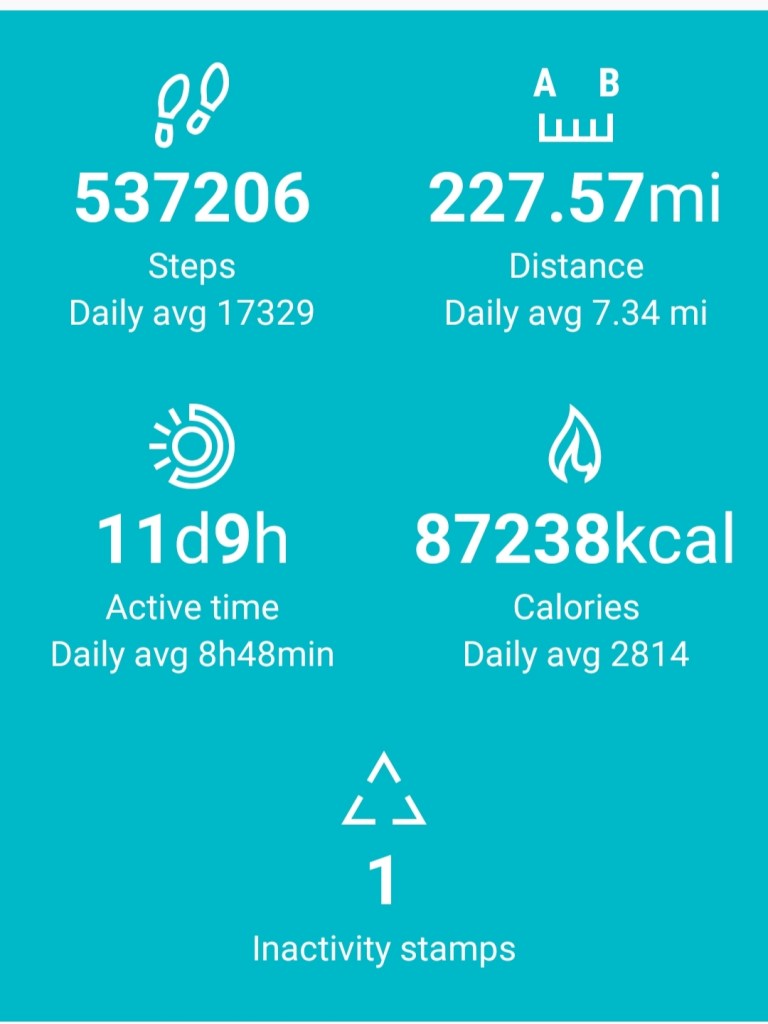
Well, I did it, or at least I hit 85% success. But by god by the end was it a pain in the arse. So here are my takeaways.
Photo by James Wheeler
If you commit to something like this keep in mind your life might change throughout the year. My training upped significantly and I went from teaching classes to becoming solely a personal trainer. Very quickly I was fully booked. This meant my activity level went up quite a good deal and keeping up with the steps some days was really tricky.
Build flexibility into any challenge. I really wish I had factored rest days in and had to add them in towards the end due to point 1.
Walking will improve your cardio fitness as long as you change speed, distance or add weight (back pack) my cardio has improved significantly and I can walk very steep hills with not much of a heart rate raise.
Walking is a great way to improve blood pressure. My BP had been a little erratic since I went into surgical menopause a few years ago and I was worried that it would start to become an issue. After the year of adding in extra steps it is now comfortably around 116/78.
I lost weight to begin with but added calories back in as I was getting super tired with all the extra training and teaching. I finished the year around the same weight although due to weight training with more muscle mass. In other words if you want to use walking as a weight loss method don’t eat anymore than you already are.
The dog will mostly love it if you have one, but even they some days will be like “for the love of god woman sit down”
Photo by Gabriela Palai
The next challenge I am starting is to see if there is any difference between walking a lot and more high intensity exercise. I will be using my Polar watch to do this. Currently it is set at the highest level of activity goal and my aim from Jan 24 to the end of Dec 24 is to hit an average of 100 percent 5 days a week. You will note the added flexibility here! Two days where I can be more restful, and the other days can be averaged which allows for a quieter day after a much busier day. I regret not allowing for averages during the walking challenge as some days I would hit 25000 steps but STILL have to do the 15000 the next day, Which beat me up a few times!
All in all though it was a reasonable challenge and if you are looking for a simple way to get fitter, reduce blood pressure and maybe lose some weight I would definitely recommend giving it a go for a year, but make it an average of 15000 steps a day over 5 or 6 days a week to allow a little wiggle room!
If you would like to have personal training in a private gym in Alnwick Northumberland please get in touch.
And I would walk 15000 steps, and I would walk 15000 more…Just to be the one who walked 15000 steps a day or more. You are very welcome for the brain worm I’ve implanted, now lets get on.
Photo by Tatiana Syrikova
As I mentioned in my post on Blue Zones aside from eating a diet devoid of processed food and high in vegetables plus fruit the centenarians moved a huge amount throughout their entire lives. In fact they on average only rest for 8 to 9 hours a day and that includes sleep, most of it is low intensity gardening, walking place to place with distances of 7 to 9 miles not being uncommon. Compare that to the UK where the average step count is a paltry 3000 to 4000 a day[1]
Photo by Alex Azabache
Movement throughout the day or Non-Exercise Activity Thermogenesis (NEAT) has a huge impact on weight, insulin sensitivity and metabolic health.[2] But I exercise I hear you cry, the question then is if we go to the gym a few times a week does that actually make up for spending the rest of the time sitting? Apparently not, if after a bout of exercise, the rest of the day is spent sitting or driving you are still losing out on your primary method of thermogenesis (calorie burning) and as a result are still at risk of a number of metabolic diseases[3]. In fact even in elite athletes sedeantary time outside of training leads to increased abdominal adiposity[4] leading the researchers to conclude
“These findings indicate that athletes with higher amounts of sedentary behaviour presented higher levels of total and trunk fatness, regardless of age, weekly training time, and residual mass. Therefore, even high moderate-to-vigorous physical activity levels do not mitigate the associations between sedentary behaviour and body fatness in highly trained athletes.”[5]
As the average age of the cohort researched was 22 this is a little concerning!
It’s not a huge surprise, then that as a nation we are getting bigger, and we are also in general getting sicker.
As hunter gatherers we would have averaged around 16 to 17000 steps a day, we would also have carried chopped and engaged in other physical activities, there are tribes who still live like this although they are becoming a rarity, when moving this much and this often-cardiovascular disease is rare[6] Perhaps it is not the type of exercise or movement we engage in that matters but how often we move, it will come as good news to those who don’t enjoy exercise that you don’t need to engage in vigorous activity either to benefit, you just need to move often. Although I would always recommend both strength training and mobility training for optimal aging.
Photo by SHVETS production
In more recent times such as the 1950s women were estimated to burn around 1000 calories on top of their basal metabolic rate (the calories needed just to exist) through walking, cleaning, cycling and other activities.[7] While men depending upon their profession could burn more through their work and commute to and from work. Few people had cars, most lived close enough to their place of occupation to walk to and from work and children would be unlikely to get to school any other way than by foot.
Now I am not suggesting we relinquish cars, washing machines and all return to working as Shepherds (though it does sound pretty idyllic) but it is clear we move less than we ever have and the truth is it is not doing anyone any good.
Photo by Rachel Claire
I came to the realisation that I was not immune from this sedentary behaviour, I like to think I am relatively fit for my age, I strength train, use a stationary bike 4 or 5 times a week, CrossFit regularly, practice yoga and walk the dog. But the truth is that although I exercise daily and walk the dog on top the rest of the day I am sat down, I am working towards my PhD which is of course desk work and I now teach and train people primarily from home.
Like a lot of people then my movement has dropped. I want to stay as healthy as I can for as long as I can and do what I can to promote a long healthy life. I decided then mid October to walk a minimum of 15000 steps a day. This is based on research on postal workers that found 15000 steps was optimal for blood pressure reduction, cholesterol reduction and many other health benefits[8] I decided initially on a period of 9 months which would take me to my 50th birthday. I then changed that to a year. I believe that to fully appreciate the benefits of any change we have to commit to a reasonable period of time as these types of changes don’t happen quickly. I am particularly interested in changes to my blood pressure, since surgical menopause it sometimes creeps higher than I would like. Not high enough for a doctor to be concerned they reassure me, but outside of the bounds I would be comfortable with. According to the American College of Cardiology a higher step count is linked to lower blood pressure.[9] I would also like to see a reduction in cholesterol, on my last check my levels were at the upper end of ok.
The rules I set myself were as follows:-
Any “steps” count for example if I cycle 15k on my bike erg my watch will register around 5 to 6000 steps. This is helpful as due to caring responsibilities I cannot always leave the house. It is important that any goal we set is achievable and fits into the life the live not the life we would like to live. Equally all steps around the house, shopping etc count. It is simply the total step count at the end of a day.
I am aiming for 90% compliance across the year, as with everything consistency is more important than perfection. There will be times I have responsibilities to others or it might be inappropriate to go for a walk, or when I am too unwell.
I will continue to exercise and eat pretty much as I was, this for the year is the adjustment I am making.
Each day has a target of over 15000 regardless of the previous day, I am not averaging across the week. So, for example if one day is 22000 steps it is irrelevant to the following days activity, I still aim for the 15000 steps. My logic on this is that if I lived in pre-industrial environment I would still need to fetch water and food that day regardless of what I had done the previous day.
I am currently at the end of 4 months and on average have exceeded my target with an average of 17000 to 18000 steps a day and within the 14 weeks have missed only one day.
That day was the day we were traveling on holiday and although I was at 11000 steps it was way too late when we arrived at our accommodation to try explore a new place. Still 1 day missed in 14 weeks is pretty good if you ask me. Things I have learned during this time trying to get over 15000 steps:-
November, December and January
Some days it’s really easy, I will be on the bike in the morning, walk the dog, train a couple of clients, run some errands and before I’m at 1 pm I have already hit the target.
Other days it’s really hard, as in oh my word how many more do I have to do today, how am I not there already and do I really need to go back outside? Really?
For me it is important to be entertained, to fit in the bike and/or walking it is part of my relaxing time, what this means is when I am on the bike I watch tv. I particularly enjoy shows with subtitles as being on the bike means I am captive in my focus, currently I’m working through a selection of Korean sci fi/supernatural dramas. Walking it’s podcasts or books, I will only listen to those books or watch those shows when I’m biking or walking. That way I actively look forward to getting back into my book and the walking is almost subsidiary. If you walk occasionally in the countryside on a beautiful day it may well be enough to just listen to the sounds of nature, if you are planning on walking every single day, in the rain, in the dark, in the snow often next to noisy dirty roads in order to fit it in the sounds around you may seem less attractive. Find something to entertain you!
Having this challenge has meant I have walked on days I would not have otherwise, when I am tired or under the weather. In the past I would have asked someone else to walk the dog, but I remind myself that if I lived in a hunter gatherer community or was a shepherdess I would only take days off if I literally could not move. You would not just stop for feeling a little under the weather. Granted those days are not dynamic walking but I am up and moving. This week for example I have a nasty sinus thing going on, I am not well enough to train or do much really but walking is so much of a neutral activity now I have been able to slowly shuffle around and get my steps in.
I don’t actually weigh myself as it’s not a metric I am particularly interested in but I have lost weight, some clothes have become looser and snug waist bands now are somewhat baggy.
My cardio has improved significantly, I walk brisker than ever with little effort and don’t feel at all breathless up hills
I am leaving measuring blood pressure etc till much later in the experiment, I will be getting I believe a full MOT at 50 which will be a good time to check over all my health stats and as it will be 9 months since I started this experiment will be a good time to assess how I am doing!
If you are reading this, start tracking your day to day movement with phone, watch or pedometer and find out how active you are outside of formal exercise.
If you would like to work with a personal trainer in a quiet setting in Alnwick Northumberland get in touch!












 Sam Kelly Fitness